Items are power; epic is rare and found
Skills gate competence and define playstyle, but the ceiling is the legendary find — rare on purpose. Power is discovered, never handed out by a level-up.
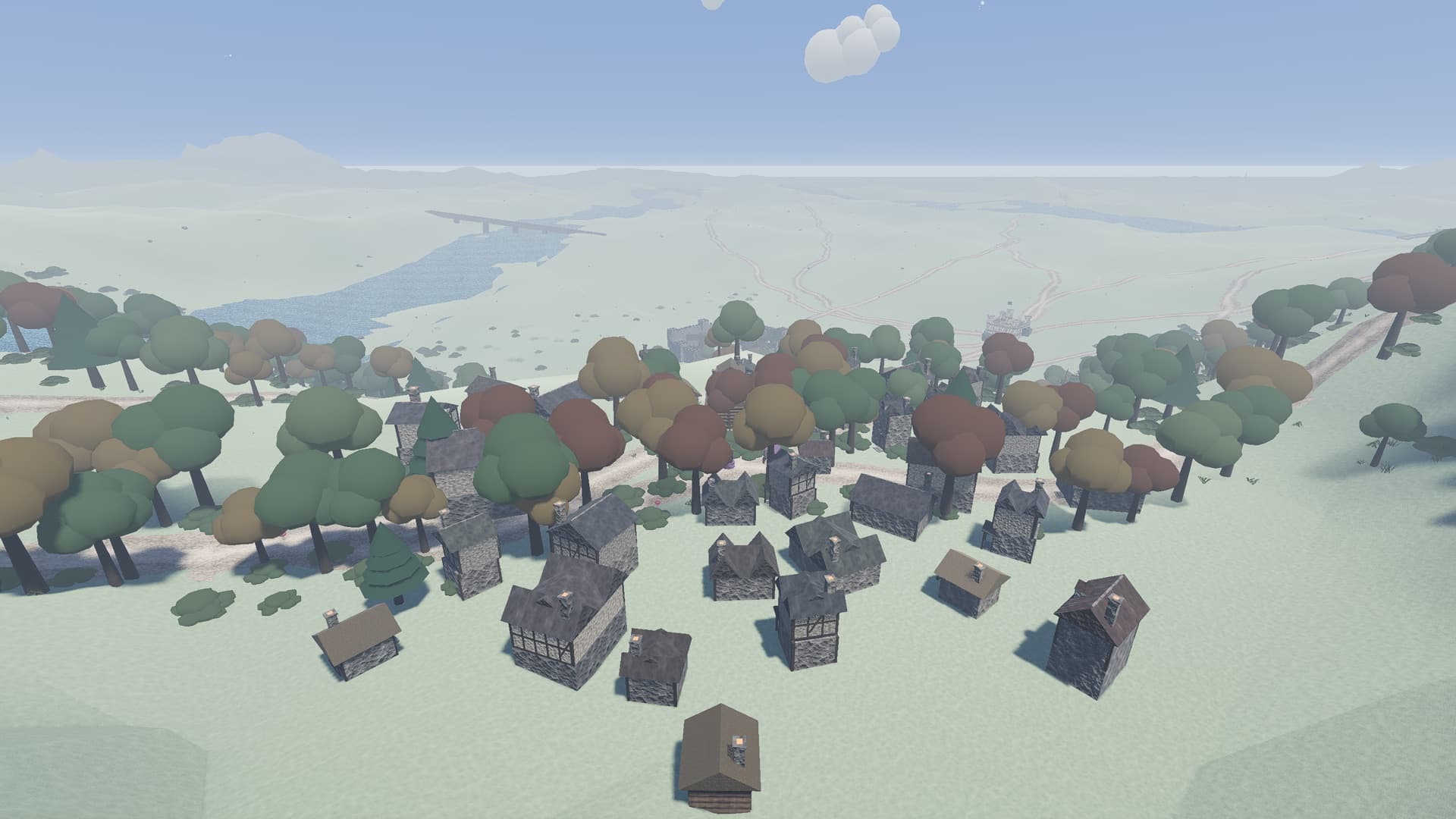
This is what Valenfeld is trying to be — pillars, loop, world, loot, progression, combat, factions, and the system that ties it all together. It's a living document, and it's being built collaboratively. If you disagree with something here, that's a conversation we want to have.
Valenfeld is a hardcore, exploration-first RPG with Morrowind's density and depth — except every faction, questline, character web, creature, item and book is authored end-to-end by an AI Dungeon Master under human guidance, validated into one interconnected canon graph, and shipped fully static.
You begin in a tiny safe corner of a world that does not care whether you live. Venture out and the stakes are real: death waits around any corner, and there's no level-scaling to flatter you. But the same world that can kill you can hand you a legendary relic out of a forgotten vase in a nameless cave. You don't become a god by leveling — you become a god by surviving long enough to find the godlike thing in the forgotten place.
The bet, in one sentence: AI gives you content volume; the canon graph plus human curation gives you Morrowind's interconnection. Volume × interconnection × curation = a density no hand-authored team can match at this budget, and a coherence no runtime-AI game can match for trust, latency, or polish.
When two pillars conflict, the higher one wins.
Skills gate competence and define playstyle, but the ceiling is the legendary find — rare on purpose. Power is discovered, never handed out by a level-up.
The world is a danger gradient, not a theme park. Going further is a gamble you choose. Lethality and the loot lottery are the engine of compulsion.
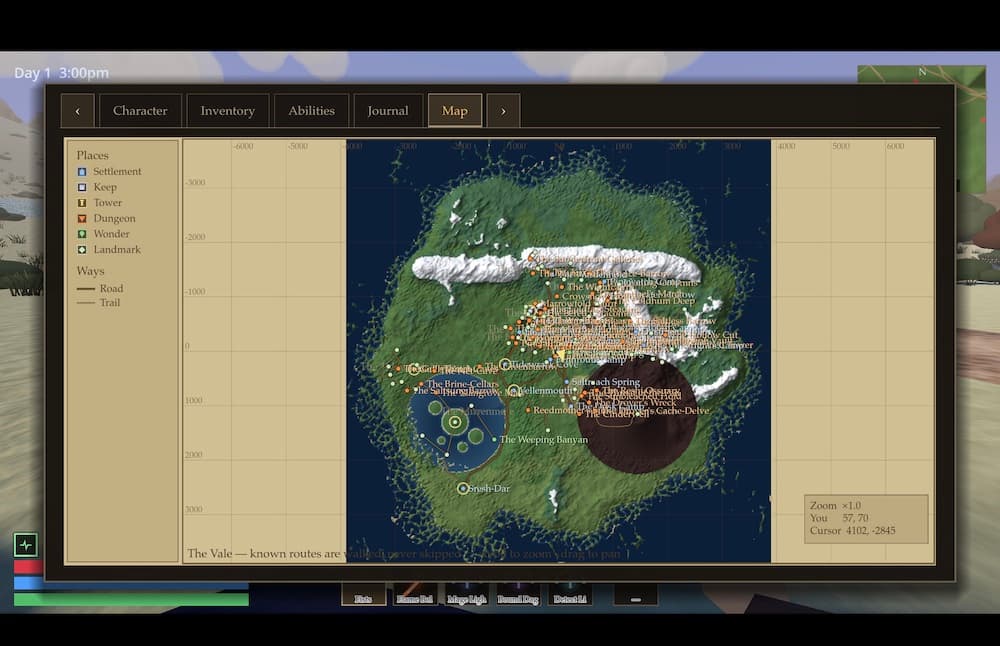
One region woven so tightly every entity connects to many others. Connection — not square kilometres — is the product. A second region exists only once the first is genuinely dense.
A journal, not a quest log. Spoken directions and landmarks, never map markers. Knowing the world is itself progression.
The AI DM writes canon, quests and changes directly. The human is the showrunner who steers by iteration. The quality wall is automated gates + self-review, not sign-off. The shipped game runs no model and touches no network.
The world is deliberately static. We reject the 'your choices remake the world' trend — the value is depth, lore and interconnection. You come to understand the world far more than you change it.
The primary player wants depth, lethality and discovery over handholding — and wants to create many different characters with different builds, discovering the world and sharing notes with friends. They're repulsed by fast travel, easy exploits and level scaling. They'll happily grind and explore for 100+ hours. They don't need fancy graphics or voice dubbing; they need a world where they can build a character that's uniquely them and play how THEY want.
Ex-EverQuest diehards, real MMO grinders, OG Elder Scrolls players, D&D and Baldur's Gate fans. They're happy to read and explore, and they find bad animation endearing. The aesthetic is brighter and more Elder-Scrolls than Morrowind's brown — low-poly and bright, but still serious, never cartoony.
Start in Valenfeld town — the one mostly-safe place. Bank gains, sell finds, train, plan the next gamble.
Decide how far past the safe corner to push today. Follow a thread — a rumor, a book that names a place, a body with a note — into more dangerous ground.
Die or flee (lose progress, learn the map) · survive (gold, gear, knowledge, more threads) · or hit the fat-tail jackpot: a legendary find. Rare, and possible anywhere.
Retreat to town to bank, sell, train, and pick the next risk. The web of citations always points at two or three more threads.
Push past the safe corner, trade safety for gold, gear, knowledge and the fat-tail shot at a legendary. Lethal, solitary, dopaminergic. This is how you accrue power.
Get caught up in a Great House questline and end up in the centre of an intrigue plot — alliances, betrayals, a relic everyone wants. This is how you spend power and find your story through the lore.
Gather, craft, steal from, trade with or murder townsfolk. Make coin buying and selling finds and paying trainers. Cities are opportunity and danger both — not a simple refuge.
Why it holds for 40+ hours: the jackpot can appear anywhere, the world is genuinely knowable so mastery compounds, and the AI-authored web always has another grounded thread to pull.
Danger is a property of place, fixed at author time. Enemies never scale to you — a novice who wanders too far should die, and should feel the danger rising before it kills them.
No markers means the world must telegraph its gradient: forbidding terrain, creatures out of your weight class, spoken warnings. You're always choosing a known-risky gamble, never ambushed by undisclosed difficulty.
Real verticality — mountains, ridges, ravines — blocks direct routes and forces you through valleys, passes and switchbacks, exactly like Morrowind. The land's shape is navigation, danger-gating and discovery at once.
Wild country feels thick — layered forest with real undergrowth, not sparse trees on mown grass. Density makes traversal deliberate and hides what's worth finding.
Towns, guilds, great houses, castles, sewers, dungeons — people to trade with, steal from, and murder. Cities are life and death and opportunity, not a safe menu.
No randomized affix rolls, no rarity colors, no farmable stat slot-machine. A glass dagger is THE glass dagger; a legendary is a discrete, named artifact with fixed properties and real lore. The whole world holds a deliberately tiny, finite, non-farmable set of standout items:
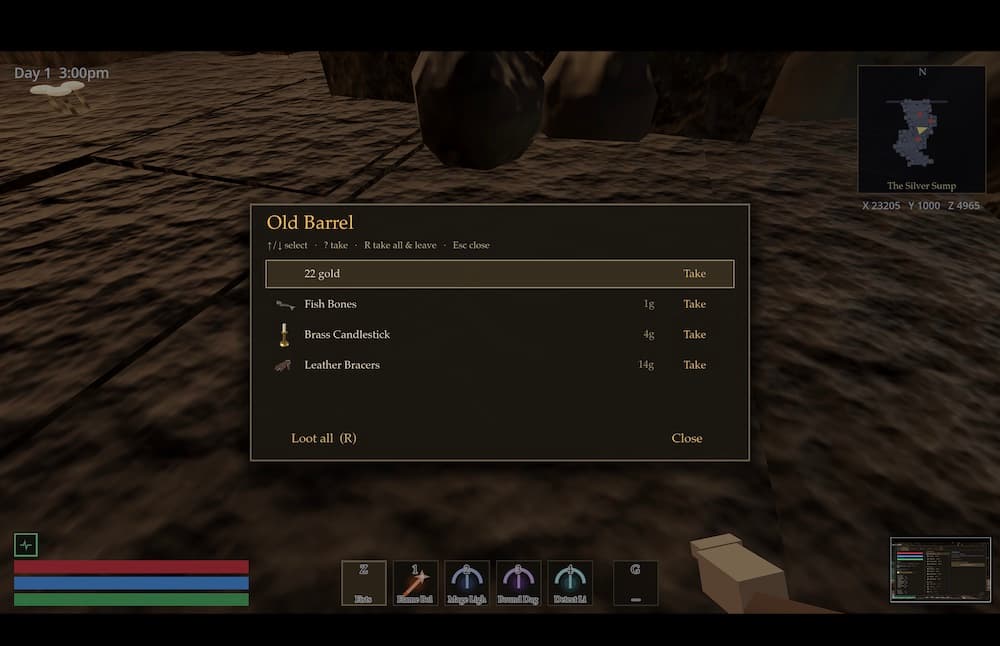
Most containers hold mundane clutter — a bowl is a bowl. Notable items are uncommon; the truly great are vanishingly rare, but possible in any container, anywhere. That's the real 'random vase in a random cave' promise.
Nothing useful is strewn on open ground. You browse a chest or a body through a loot panel and take items one at a time. Rarity is never labelled or colour-glowed — you know it's rare by what it does.
An item's power lives in magic effects, not inflated base stats. Potions, scrolls, enchanted gear, spells and techniques all run the same atoms through the same resolver. A rare blade is a plain blade that burns.
A slain beast yields what it was — hide, ash, a trophy — never a sword out of its belly. You arm up by surviving to a chest or earning the coin, not by farming mob drops.
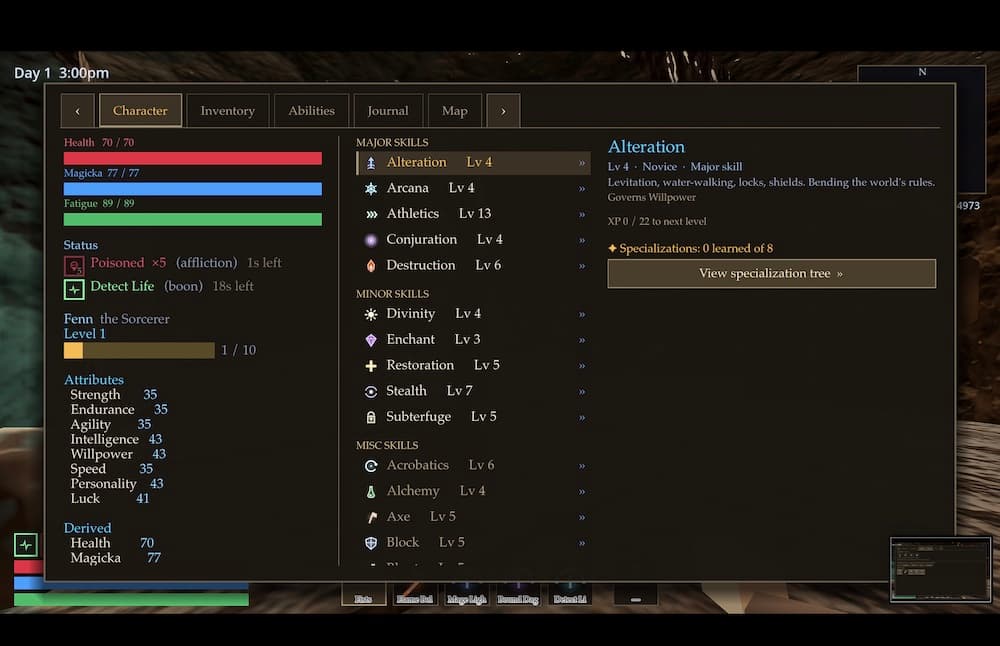
You become what you do. Using a skill levels that skill; ten skill-ups in your major/minor skills earns a character level. No class, no point-buy build at creation — your calling is a starting hand, not a cage.
29 skills across five groups — combat, magic, stealth, craft, misc. Weapon skills are Morrowind-complete (one per weapon type); armor trains Heavy or Light by what you wear and weather.
Each level grants health, 10 attribute points you allocate by hand, and a skill point. Your level sets the ceiling a skill can climb to — you can't tunnel one skill to mastery while ignoring everything else.
Your chosen calling unlocks free; every skill outside it is locked until you pay a trainer to begin it. Gold is the master pacing dial for branching beyond who you said you were.
Every skill has a 4-tier specialization tree (forks at levels 10/25/50/75, two siblings per tier). Take one node and its sibling is foreclosed for good. No respec. Two Long Blade users can play nothing alike.
Versatile and lucky; no weakness, no native echo-attunement. The baseline every other race trades against.
Fire/ash resist, Willpower; Destruction and ancestor-ward affinity.
Breathe water, disease-immune, poison resist, Agility.
Night-eye, Agility/Speed/Luck, stealth; frailer.
Endurance/Strength, poison & magic resist, smithing; slow.
Big magicka, echo-attuned, keen; frail and shock-weak.
Strength/Endurance, frost resist; poor at and weak to magic.
You move and click in real time on the live map, but the outcome is rolled, never twitch-timed. No charge-timing, no parry windows, no aim skill. Whether your blow lands is a to-hit roll; whether a spell goes off is a cast roll. Your build and stats decide the fight.
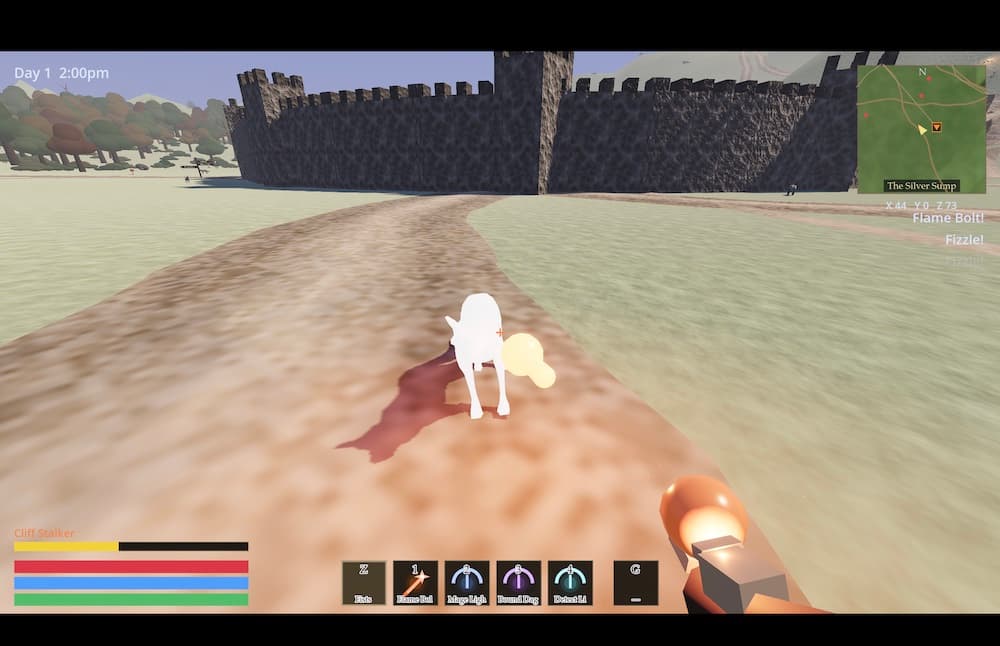
Low fatigue tanks your to-hit, spikes your fizzle chance, and cuts your damage. Sprinting into a fight makes you whiff. Fatigue management is the skill that replaces reflex timing.
Enemies carry legible threat tells; a skill-gated assess read tints a foe's name white (even) to deep red (suicide). The deepest combat skill is knowing which fight to take.
No floating combat text. The enemy's health bar reads out on the HUD on first contact and fades out of combat — quiet, diegetic, marker-free.
A single fighting stance (weapon drawn or sheathed); every ability — spell or martial technique alike — binds to a 4-slot skillbar and fires instantly. A fighter and a mage share the exact same controls.
Health, Magicka, Fatigue, and an in-world clock with sleep and rest. Lethality is real; death is not permanent.
No permadeath, no run-loss — dying reloads your last save. The cost is lost progress and the tension of the moment, which is enough to make the gamble matter. This is not a roguelike.
The pack holds any number of items — one open Morrowind-style field — bounded by carry weight off Strength + Endurance. A deep haul is a real decision: what do I leave behind? No inventory tetris.
Treading water drains Fatigue and you can't regen it while afloat. Run Fatigue to zero in deep water and you sink and drown. Open water is a real crossing-decision, not a free shortcut.
Track skittish wild game for raw meat and a hide to sell. Raw meat can turn your stomach — cook it at a fire. Forage, brew, manage fatigue, sleep, and wait out the weather.
Long ago the Sundering shattered something fundamental in the Vale, and the land never stopped ringing. Every faction is, underneath, an answer about the echoes — and the relic at their heart, Sunder's Echo. The five great powers each take a side of the core question: fade · seal · sell · wield · legitimize.
A frontier administration enforcing a dead empire's law. The cost: Order in service of a lie.
Vale-born grief-keepers whose craft is letting go. The cost: Peace, and the poorest reward.
A militant reform faith: the echoes are a sickness to be bound. The cost: Salvation through erasure.
Relic-runners and echo-brokers who price the dead's leavings. The cost: Coin; the Vale a little emptier.
Scholar-sorcerers who would understand and wield the echoes. The cost: Knowledge that doesn't ask permission.
Most playstyle guilds are an arm of a great power, so how you play pulls you toward a stance on the relic — which you can later betray. Each is authored as a subgraph 5× the depth of a Morrowind guild.
Doubles as: Neutral — the sword everyone hires
Doubles as: The Resonants (wield)
Doubles as: The Gaunt Ledger (sell)
Doubles as: The Choir (seal)
Doubles as: The Mourners (fade)
Doubles as: An independent counterweight
The flagship questline — The Barrow Relic — is a five-way fork, one ending per great power, where the cleanest ending pays the worst. No faction is clean, every choice costs, and the choice is permanent. The outcome is a local resolution, not a cascade that reshapes the Vale.
This is the differentiator, designed as a system, not a content folder. Entities — places, factions, characters, creatures, items, events, concepts, texts, quests — are nodes; the edges between them are the product. Density lives in the edges.
Every batch of new entities proposes at least as many new edges. Any entity sitting on fewer than 3 edges is flagged. We connect existing things before inventing new ones.
No generic bandits. Every dungeon ties to at least one faction — a 'bandit crew' is really a Gaunt Ledger cell. Every in-world book cites other entities; books are density gold.
Schema validation is a hard wall; canon-density and citation checks flag thin spots; reweave passes cut forced or contradicted edges. The AI authors canon directly and self-reviews; the human curates by exception.
Summaries bake into a resident graph; full dialogue, book texts and quest scripts stay as lazy side-files loaded on demand. The finished game runs no generator and touches no network.
The systems machine plus a playable slice proving combat, skills, magic, the journal, crime/bounty, and the relic spike.
The Vale grown to ~40 woven canon entities; the Barrow Relic playable through all five branches; danger gradient and loot lottery tuned; the loop compelling for 3–5 hours. The proof of the whole bet.
Curation tooling matured; a second and third region authored at Vale density; faction questlines with branching depth; the procedural legendary tail seeded and tuned.
Content-complete pass, balance, polish, static bake, ship.
And you get a say in it.
Valenfeld is in active, collaborative development. Sections of the real design doc are still open questions. If you're the kind of player this is for, your read on these decisions is exactly what we want — come argue with us.
Come build it with usValenfeld is in active, open development — a labor of love being shaped in real time. We're not shipping a polished product and asking you to buy it. We're a small studio and a growing community of Elder-Scrolls diehards trying to make the coolest Scrolls-like ever made, and we want YOU in the room while we do it. Your ideas, your gripes, your wishlist — they go straight into the design.
Download it, break it, get lost in the Vale. It's early and rough on purpose — that's the point. Tell us what felt great and what felt awful.
This is a collab. The factions, the systems, the lore — open questions we're working out loud. Pitch a mechanic, argue for a race, name a relic. Good ideas get built.
A Discord of people who are genuinely excited about a new Scrolls-like — that's the heart of it. Hang out, follow the dev, and help steer where it goes.
We're after a community of people who want exactly the game we want: deep, lethal, hand-crafted-feeling, no handholding, all discovery. Is that you?