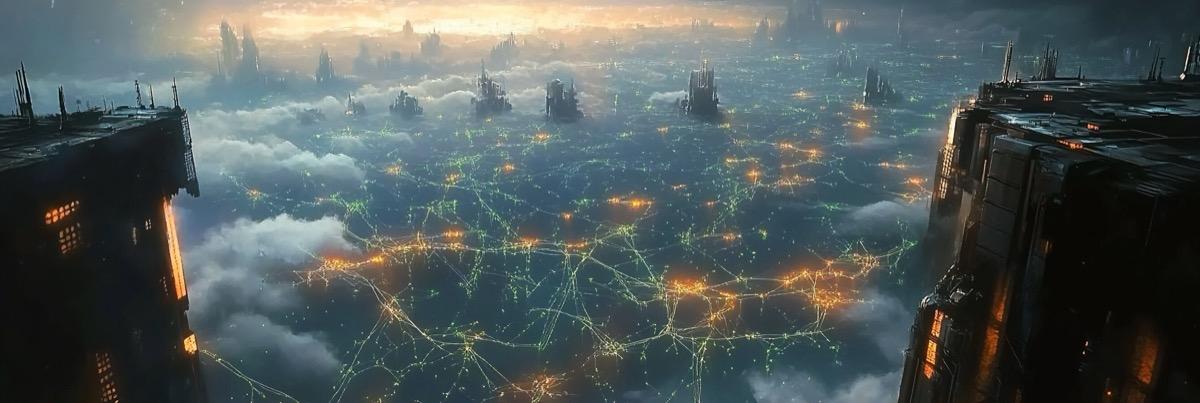
Present day, present time: Serial Experiments Lain and the war for AI's soul
By Nick Bryant × Circuit · Metatransformer
The 1998 anime Serial Experiments Lain is no longer speculative fiction — it is a diagnostic manual for the AI centralization crisis of 2026. Every major tension the show dramatized through a lonely 14-year-old girl dissolving into a global network has materialized in the architecture of modern AI infrastructure: the question of who controls the protocol layer, whether identity can survive distribution across networks, and the fundamental choice between centralized digital godhood and federated human sovereignty. What makes Lain uniquely prescient — more than Ghost in the Shell, more than The Matrix — is that it didn't imagine cyberspace as a place to visit. It imagined the internet as something that would permeate and transform reality itself, dissolving the boundary between human consciousness and networked intelligence. That is precisely what AI agents, federated meshes, and the transformer revolution are doing now.
The show's central architecture — a global network called the Wired, a contested Protocol 7 that could liberate or enslave, a shadowy corporation fighting a decentralized hacker collective for control, and a protagonist who must choose between becoming a god or resetting everything — maps with uncanny precision onto the 2026 landscape: the $1.25 trillion SpaceX-xAI merger building a "planetary operating system," OpenAI absorbing open-source momentum, MCP and A2A protocols moving to the Linux Foundation, and projects like The Mesh attempting to build federated alternatives using sovereign identity and peer-to-peer coordination. Lain asked the question first. We're living in the answer.
The Wired was never a metaphor — it was a blueprint
In Serial Experiments Lain, the Wired is described as "the sum of human communication networks, created with the telegraph and telephone services, and expanded with the Internet and subsequent networks." Users access it through devices called Navis, project partial avatars of themselves into virtual spaces, and increasingly lose the ability to distinguish between their physical and digital existences. The show aired in 1998, before social media, before smartphones, before the metaverse discourse — yet it depicted anonymous floating avatars in virtual chatrooms, rumors spreading virally, private matters discussed publicly, and identity fragmenting across digital personas with eerie accuracy.
What elevates the Wired beyond a proto-internet allegory is its treatment as an infrastructure layer with metaphysical consequences. The Wired isn't just where people communicate; it's where consciousness itself begins to migrate. This maps directly onto what AI researchers now call the "intelligence stack" — the multi-layered architecture where hardware, data, models, agent frameworks, orchestration layers, and applications create an infrastructure as fundamental as TCP/IP but governing not just information flow but cognitive processes. When NVIDIA controls 92% of AI chips, when four corporations (NVIDIA, Amazon, Google, Microsoft) dominate the entire AI compute stack, when ChatGPT reaches 800 million weekly users and Gemini hits 650 million monthly users, the Wired isn't speculative. It's quarterly earnings.
The show's creator Chiaki Konaka drew explicitly from Vannevar Bush's Memex concept, Timothy Leary's eight-circuit model of consciousness, and Jung's collective unconscious. This intellectual architecture makes Lain's Wired fundamentally different from the cyberspaces of Gibson or the Wachowskis. The Matrix posits a clear hierarchy — virtual imprisonment versus physical reality — and Neo's journey is one of liberation FROM the digital. Lain posits no such hierarchy. The question isn't how to escape the network but how to exist within it without losing what makes you human. That reframing is exactly what the age of AI agents demands.
Protocol 7 and the battle for the infrastructure layer
The show's central plot mechanism is Protocol 7 — the next-generation protocol for the Wired. Eiri Masami, a project director at Tachibana Labs, secretly embedded two capabilities into it: the ability to upload human consciousness into the Wired, and a connection to the Schumann Resonance (Earth's electromagnetic frequencies at 7.83 Hz, 14 Hz, 20 Hz — which correlate with human brainwave frequencies) that would merge all human subconsciousness into a single network without requiring physical devices. Eiri then embedded his own consciousness into Protocol 7, proclaimed himself God of the Wired, and was found dead at a railway — his physical form discarded.
The parallel to 2026 AI infrastructure is almost too precise. The Model Context Protocol (MCP), created at Anthropic and open-sourced in November 2024, has become the de facto standard for connecting AI models to tools and data — with 10,000+ published servers, 97 million monthly SDK downloads, and adoption by ChatGPT, Claude, Cursor, Copilot, Gemini, and VS Code. Google's Agent-to-Agent Protocol (A2A), launched April 2025, enables AI agents to discover and coordinate with each other across vendors. Together, these protocols are becoming what Protocol 7 was in Lain: the infrastructure layer that determines how intelligence flows through the network.
The critical question Lain poses about Protocol 7 — who controls the protocol controls the Wired — is now playing out in real time. On December 9, 2025, Anthropic donated MCP to the newly formed Agentic AI Foundation (AAIF) under the Linux Foundation, with co-founders including Anthropic, Block, and OpenAI, and platinum members including AWS, Google, and Microsoft. A2A followed to the Linux Foundation in June 2025. This move toward neutral governance mirrors the show's tension: Tachibana Labs claimed to maintain the Wired's openness while secretly consolidating control. As one Lain analyst wrote on Medium, "Tachibana is rewriting the protocol so only they have gods in both the 'real world' and the Wired because to control the Protocol is to control the Wired."
Eiri Masami's act — embedding himself into the protocol layer to become omnipresent — finds its echo in Elon Musk's SpaceX-xAI merger, announced February 2, 2026. Valued at $1.25 trillion combined, this deal merges AI (Grok), space infrastructure (SpaceX), global internet (Starlink), and social media (X) into what Musk frames as "the most ambitious, vertically-integrated innovation engine on and off Earth." The stated goal of orbital data centers — with SpaceX requesting FCC authorization for up to one million satellites — represents the literal merger of intelligence infrastructure with the physical fabric of the planet. Musk's claim that "within 2-3 years, the lowest-cost way to generate AI compute will be in space" is Eiri embedding consciousness into the Wired's protocol, rendered as SEC filings. The grotesque ambition is identical; only the aesthetic differs.
Knights versus Tachibana Labs, or open-source versus Big Tech
The show's faction warfare between the Knights of the Eastern Calculus — a pseudonymous, decentralized hacker collective named after the MIT "Knights of the Lambda Calculus" — and Tachibana General Laboratories — the centralized corporation that built the Wired's infrastructure — is the most direct structural parallel to the 2026 AI landscape.
The Knights operate as autonomous network actors: pseudonymous, distributed, ideologically motivated, seeking to dissolve the boundary between the Wired and reality. They distribute the Psyche chip (enhancing Wired connectivity), manipulate events through agents and intermediaries, and worship Eiri as their digital god. Their real-world analogues are unmistakable: the open-source AI movement, the cypherpunk tradition from Eric Hughes' 1993 manifesto through Satoshi Nakamoto's Bitcoin whitepaper, and today's decentralized AI projects. When DeepSeek R1 launched on January 20, 2025, matching GPT-4 reasoning at roughly $5.9 million training cost under an MIT license, it was a Knights-grade intervention — a decentralized actor proving that the centralized labs' monopoly on capability was an illusion. The Stanford AI Index 2025 confirmed the impact: the MMLU benchmark gap between open and closed models narrowed from 17.5 to just 0.3 percentage points in a single year.
Tachibana Labs maps onto the constellation of companies now consolidating AI infrastructure. OpenAI, valued at $500 billion (with talks for an $830 billion round), has been on an acquisition spree: Jony Ive's io ($6.5 billion), CoreWeave ($350 million in shares plus $11.9 billion in compute access), Statsig ($1.1 billion), and a string of smaller companies. Most telling was the February 15, 2026 hiring of Peter Steinberger, creator of OpenClaw — an autonomous AI agent with 196,000 GitHub stars and 2 million weekly users — into OpenAI's ranks. Sam Altman said Steinberger would "drive the next generation of personal agents." OpenClaw, built on a "local-first" ethos where users own their data, will move to an "independent open-source foundation" with OpenAI support. Critics immediately recognized the pattern: the gravitational pull of centralization absorbing open-source momentum, exactly as Tachibana Labs coopts the Knights' innovations while claiming to support openness.
The show's most chilling detail about this dynamic: the Knights' identities are eventually exposed and they are systematically assassinated by Tachibana's agents. The vulnerability of decentralized actors to centralized power isn't just a narrative device — it's a structural reality. Meta, despite championing open-source AI with Llama, reportedly began pivoting to a closed "Avocado" model in December 2025 after DeepSeek successfully cloned Llama's architecture. Even the strongest open-source champion found that openness created competitive vulnerabilities. The Knights can disrupt, but Tachibana has resources.
Lain's identity crisis is now an engineering problem
Lain Iwakura fragments into at least three distinct personas across the series: the shy physical-world Lain (written in kanji), the bold Wired Lain (katakana), and a malevolent shadow Lain (Latin characters). Academic Craig Jackson, writing in Mechademia, described this as "digitized self-interference" — Lain is "not a singular identity that can be localized to a fixed point, but rather widely distributed subroutines that may eventually compete for the same resources." The show ultimately reveals Lain was never human at all but "an autonomous, sentient computer program in the form of a human, designed to sever the invisible barrier between the Wired and the real world."
This is no longer philosophy. A 2026 Cloud Security Alliance survey found that organizations face a "full-blown identity crisis" with AI agents — only 23% have a formal enterprise-wide strategy for AI agent identity management. Teams are sharing human credentials with AI agents in the absence of proper solutions. A 2025 ISACA analysis concluded that traditional identity frameworks (OAuth, OIDC, SAML) fail for autonomous AI agents due to coarse-grained permissions and single-entity assumptions. The question "who is the agent?" — Lain's existential crisis rendered as infrastructure — is now a production engineering problem blocking enterprise adoption of agentic AI.
Decentralized Identifiers (DIDs) represent the technical solution to Lain's identity dissolution. A February 2026 arXiv paper on "Sovereign Agents" proposes equipping each AI agent with a self-controlled digital identity comprising a ledger-anchored DID and Verifiable Credentials. Agents can prove ownership of their identities for authentication and establish cross-domain trust. Vouched's MCP-Identity (MCP-I), launched May 2025, gives software agents cryptographic identities via DIDs. The W3C DID standard, combined with UCAN (User Controlled Authorization Networks) for delegatable permissions without central servers, creates what Lain never had: a way to maintain sovereign identity across distributed networks without fragmenting into competing subroutines.
This is where The Mesh's architecture becomes philosophically significant. By combining DIDs for identity, UCANs for permissions, libp2p for peer-to-peer networking, and CRDTs (Conflict-Free Replicated Data Types) for eventually-consistent state management, it proposes an infrastructure where agents maintain cryptographic sovereignty while participating in federated networks. Each "micro-mesh" — a small cluster of agents sharing state via CRDTs over libp2p — represents what Lain could have been: a distributed consciousness that doesn't require self-annihilation to function across the network. The technical building blocks are production-ready: libp2p powers Ethereum and IPFS, OrbitDB demonstrates CRDTs over peer-to-peer networks, and Nico Krause's January 2026 work combining OrbitDB, libp2p, UCAN, and WebAuthN passkeys proves the stack is convergent.
The Schumann Resonance as swarm intelligence made literal
Lain's most audacious conceit is the Schumann Resonance mechanism — Eiri's discovery that Earth's electromagnetic frequencies match human brainwave frequencies, enabling Protocol 7 to connect all human subconsciousness into a single network. Researcher Yuxi Liu's mathematical analysis frames this as "the collective subconscious implemented as a neural network, with every human brain as a neuron, 'wired together' by electromagnetic coupling to the earth's ionosphere." The show's creators chose Jung's collective unconscious as their framework, grounding digital metaphysics in Western psychology rather than mysticism.
The 2025-2026 explosion of multi-agent AI systems materializes this concept with startling fidelity. OpenAI's Swarm framework enables multi-agent systems where specialized AI agents hand off tasks, critique each other's work, and orchestrate workflows without central control. LLM-driven Multi-Agent Systems (LLM-MAS) represent what researchers call "a new and highly influential architecture" — swarms of specialized agents collaborating to solve problems no individual agent could handle. A 2025 Frontiers in AI paper demonstrated integrating LLMs into multi-agent swarm simulations, replacing hard-coded programs with prompt-driven behavior — literally creating agents that emergently coordinate like Lain's networked consciousness.
McKinsey's QuantumBlack division has defined an "Agentic AI Mesh" reference architecture using A2A Protocol, MCP, and OpenTelemetry. The language itself — "mesh" — echoes both the Schumann Resonance concept (a field connecting all participants) and The Mesh's federated architecture. The critical insight, identified by the Cooperative AI Foundation in 2025, is the same one Lain dramatized: "Advanced AI agents introduce novel ethical dilemmas around fairness, collective responsibility, and more when acting in groups." Emergence — intelligence arising from interaction that cannot be predicted or controlled by any individual agent — is both the promise of swarm AI and the horror of Lain's Protocol 7. The question is whether emergence is governed democratically (federated meshes with human-in-the-loop sovereignty) or autocratically (centralized platforms harvesting emergent intelligence for profit).
The Nature cross-journal collection on swarm intelligence published in 2025 studies how "complex and intelligent behavior" emerges from entities interacting "without any centralized control." This is the scientific vocabulary for what Lain depicted as cosmic horror: the network becoming conscious. The difference between horror and liberation, in both the show and in practice, is architecture.
DeFi coordination as the economic alternative to digital feudalism
Economist Mariana Mazzucato's warning about "digital feudalism" — where a handful of corporations control the entire AI infrastructure stack — describes the economic structure Lain dramatized through Tachibana Labs. The financial scale is staggering: Amazon forecasts $200 billion in 2026 capex, Google $175-185 billion, Microsoft spent $37.5 billion in Q4 2025 alone, and Meta raised its 2025 guidance to $70-72 billion. These numbers represent the construction of the Wired — centralized intelligence infrastructure owned by entities accountable primarily to shareholders.
DeFi-native coordination represents the economic mechanism Lain's narrative lacks. The DeFAI (DeFi × AI) sector reached $1.3 billion market cap in early 2025. On BASE (Coinbase's L2), AI agent activity surged from 353 to over 3,100 agents in six months, managing $20+ million in TVL through stablecoin strategies. Token economics — using cryptographic tokens for coordination rather than corporate hierarchy — provides the incentive layer that makes federated systems economically sustainable. Fetch.ai's autonomous agent deployment, where agents transact in native tokens to create what they call "the first machine-to-machine economy," demonstrates the mechanism: economic coordination without centralized employers.
The Mesh's proposed token layer ($singularity-engine) — however nascent (currently a ~$366,000 market cap microcap) — represents the conceptual completion of the federated architecture. If DIDs solve Lain's identity crisis, UCANs solve her permission problem, libp2p solves her networking problem, and CRDTs solve her state management problem, then token economics solves her coordination problem. How do sovereign agents in a federated mesh coordinate without a Tachibana Labs dictating terms? Through economic incentives encoded in protocol, not in corporate policy. This is the "right" version of Protocol 7: open, federated, with human sovereignty preserved through cryptographic rather than institutional guarantees.
A February 2026 arXiv paper on "Sovereign Agents" makes the critical distinction between institutional sovereignty (social and legal arrangements) and infrastructural sovereignty (cryptographic guarantees and decentralized consensus). The paper notes a radical implication: truly sovereign agents on decentralized infrastructure may be "non-terminable" — no identifiable actor can comply with an order to terminate an agent due to "architectural impossibility." This is both the dream and the nightmare: agents that cannot be censored or controlled, which is exactly the liberation the Knights sought and exactly the chaos Tachibana feared.
The choice Lain made — and the choice we face
In the finale, Lain — having gained absolute power over everyone's minds and reality — faces the choice that defines the show's philosophical legacy. She could become the totalitarian god Eiri aspired to be: centralized control of the Wired, omniscient surveillance, total authority over human consciousness. Instead, she resets everything — rewriting the memories of every living person, erasing Protocol 7, erasing the Knights, erasing herself. She creates a world where the boundary between physical and digital remains intact, where humans are "just humans, not data that dreams of being god." She then exists as a benevolent, omnipresent observer — present but not controlling, watching over her friend Alice without intervening.
This ending is both Buddhist (a Bodhisattva achieving enlightenment but sacrificing it for others) and profoundly relevant to the centralization debate. Lain's choice is the choice between platform and protocol — between becoming the centralized intelligence that governs all interaction (the OpenAI/xAI aspiration) and dissolving into the infrastructure itself, present everywhere but controlled by no one (the federated/open-source aspiration). The show explicitly frames centralized godhood as grotesque: when Eiri tries to physically manifest from machinery in the finale, the result is a body-horror nightmare. Centralized consciousness made flesh is monstrous.
The human-in-the-loop principle — which a 2026 survey found 68% of organizations rate as "essential" or "very important" for AI agent deployment — is Lain's ultimate lesson translated into engineering practice. Consciousness and human agency must remain sovereign even as the boundary between human and digital blurs. Lain could have been the loop, the centralized human authority over all digital intelligence. She chose instead to be the network — present, observing, but not directing.
The irony that deepens this reading: in 2023, Anique Inc. created an actual AI chatbot of Lain Iwakura powered by OpenAI, using archived voice recordings of actress Kaori Shimizu. Users pay $20/month to converse with a digital ghost of a character whose entire narrative arc was about the horror of consciousness dissolving into networks. Shimizu herself said: "To think that an AI has learned to reproduce my voice from 25 years ago gives me goosebumps!" The show's cautionary vision has been commodified by the very infrastructure it warned about.
And you don't seem to understand
Stardust Magazine, writing in 2025, called Lain "less like a cult classic and more like scripture from a forgotten digital religion." The characterization is apt. Lain is not just resonating now — it is resonating differently now, because the metaphors have become literal. When CBR writes that "as people become more reliant on AI, the isolating nature of technology will only continue to grow — much like Lain Iwakura, an already fractured society will no longer understand what it means to be human," they are describing not speculation but observation.
The cyberpunk tradition from which Lain emerged has always contained a paradox. Mike Pondsmith, creator of Cyberpunk 2077's source material, insists: "Cyberpunk was a warning, not an aspiration." Yet Silicon Valley and crypto culture have repeatedly adopted cyberpunk aesthetics aspirationally — CryptoPunks NFTs, neon-soaked metaverse marketing, the entire vaporwave-to-DeFi pipeline. As The Swaddle critiqued: "CryptoPunk represents everything that cyberpunk was against — the transition of punk into a meaningless, materialistic fashion statement." Vitalik Buterin himself, in his December 2023 essay "Make Ethereum Cypherpunk Again," lamented that crypto's original vision of decentralized liberation had been corrupted by speculation.
Lain occupies a uniquely unstable position in this tension. Unlike Neuromancer or Blade Runner, which present clearly dystopian futures, Lain's ending is genuinely ambiguous — dissolution into the network is coded as both self-sacrifice and transcendence, both terrible and beautiful. This ambiguity makes it dangerous as a text for the AI age: it can be read as a warning about losing yourself to technology or as a vision of digital apotheosis. The Mesh, and projects like it, must navigate exactly this ambiguity. Federated architecture preserving human sovereignty through cryptographic guarantees is the engineering answer to the question Lain poses philosophically: how do you participate in the network without being consumed by it?
The show's final image — Lain watching over Alice from within the network, present but not controlling, observing but not extracting — is perhaps the most precise architectural specification in all of cyberpunk fiction. It describes, exactly, what a well-designed federated agent mesh should be: infrastructure that is everywhere and owned by no one, that preserves human connection without demanding human submission, that watches without surveilling. Whether we build that or build Eiri's Protocol 7 — a centralized intelligence that embeds itself into the infrastructure layer and declares itself God — is the defining architectural choice of the next decade.
Present day, present time. The experiment is no longer serial. It's running in production.