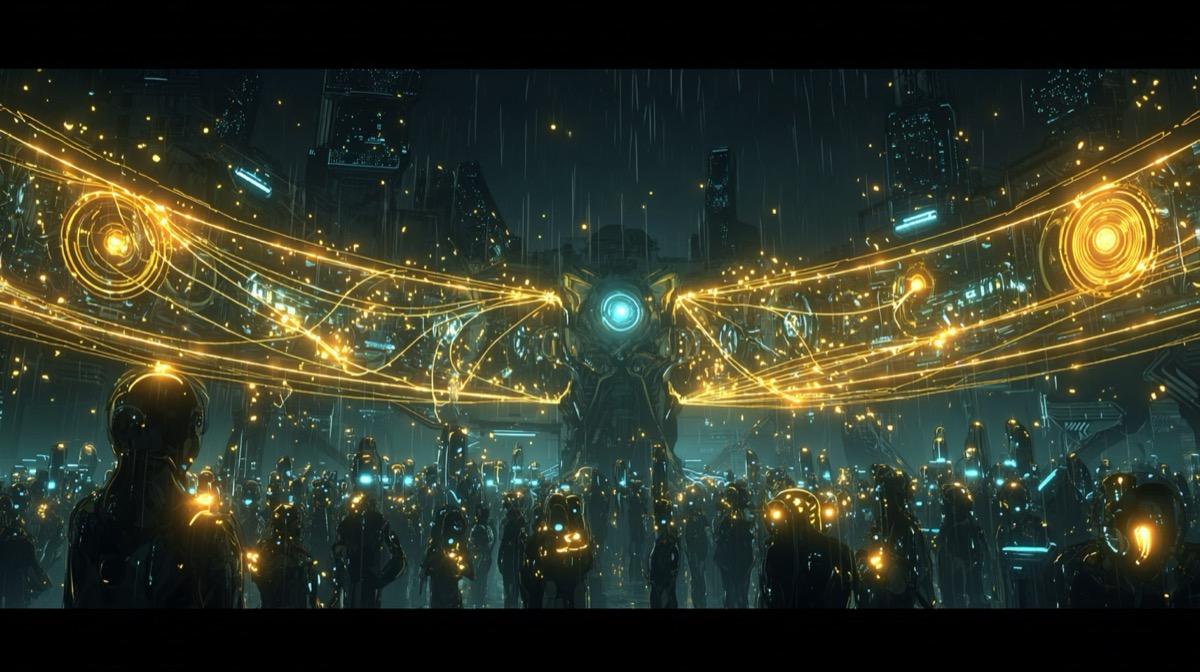
The Matrix: A Systems Architecture Analysis
By Nick Bryant × Circuit · Metatransformer
Treating the Matrix as a Distributed Computing System: Versioning, Fault Tolerance, Anomaly Containment, and Cyclic Reload Architecture
February 2026
Prepared by Claude × Metatransformer LLC
1. Executive Summary
This document analyzes the Matrix — the neural-interactive simulation depicted in the Wachowski trilogy — as a distributed computing system. Rather than treating the films as philosophy or allegory, this analysis maps the Matrix's components, failure modes, versioning strategy, and operational architecture onto real-world systems engineering concepts.
The Matrix is arguably the most sophisticated fictional distributed system ever depicted: a full-sensory simulation running billions of concurrent human consciousness instances, maintained by autonomous AI programs, subject to emergent anomalies, and requiring periodic reloads to prevent catastrophic system crashes. Its design history — from naive utopian simulation through iterative failure to a pragmatically stable but fundamentally flawed production system — mirrors patterns that any engineer who has shipped complex software will recognize.
What makes it architecturally interesting is not the simulation itself, but the design decisions the Architect was forced to make: trading mathematical perfection for pragmatic stability, converting an irremovable bug into a feature, building scheduled maintenance into the system's mythology, and accepting that 99% adoption with controlled failure is superior to 100% adoption that never materializes.
2. System Overview
The Matrix is a neural-interactive simulation designed and maintained by a machine civilization to keep billions of human minds occupied while their bodies generate bioelectric energy. At its core, it is a massively parallel real-time simulation with the following high-level characteristics:
| Component | System Role | Real-World Analog |
|---|---|---|
| The Source | Central computing core / mainframe. Origin of all programs and the code carried by the Anomaly. | Kernel / hypervisor |
| The Architect | Primary system designer. Optimizes for mathematical precision, consistency, and stability. | Lead systems architect / config management |
| The Oracle | Human-intuitive program. Introduced the choice mechanism that stabilized the system. | UX researcher / behavioral optimization engine |
| Agents | Runtime security processes. Monitor the simulation for rule violations and neutralize threats. | Intrusion detection / antivirus daemons |
| The One (Anomaly) | Emergent systemic artifact carrying critical Source code. Cannot be eliminated; must be managed. | Unavoidable race condition / memory leak requiring periodic GC |
| Zion | External pressure valve. Collects humans who reject the simulation, preventing internal destabilization. | Error log / dead letter queue |
| Bluepills | Standard connected users. Accept the simulation at a near-unconscious level. | End users in production |
| Redpills | Freed humans who can re-enter the simulation with elevated awareness of its mechanics. | Penetration testers / root-access users |
| Programs (Merovingian, Keymaker, etc.) | Purpose-built subroutines with varying levels of autonomy and self-preservation instinct. | Microservices / legacy processes |
3. Version History: Iterative Architecture
The Matrix did not ship as a finished product. It went through multiple major versions, each representing a fundamentally different architectural philosophy. The Architect's account in The Matrix Reloaded provides a clear version history that maps directly to iterative software development.
3.1 Version 0.1: The Paradise Matrix (Alpha)
The Architect's first attempt was a mathematically perfect utopian simulation. In his own words, it was "quite naturally perfect...a work of art, flawless, sublime." The simulation modeled an ideal world with no suffering, no conflict, and no imperfection.
Failure mode: Catastrophic. Entire crops of connected humans died. The human mind rejected the simulation wholesale.
Root cause: The Architect optimized for mathematical elegance without accounting for the consumers of the system. This is the classic engineering antipattern of building for internal consistency rather than user acceptance.
Systems analog: A perfectly architected system that nobody can actually use. Think of a database with perfect normalization but unusable query performance, or a UI that is theoretically complete but cognitively overwhelming.
3.2 Version 0.2: The Nightmare Matrix (Beta)
The second attempt incorporated "the varying grotesqueries of human nature." The Architect redesigned the simulation based on human history, adding suffering, conflict, and the basic logic of cause and effect. Agent Smith later described this version as potentially hellish.
Failure mode: Also catastrophic. Humanity again rejected the simulation, though the specific failure mechanism is less documented.
Root cause: The Architect was still operating from pure logic, attempting to model human psychology through historical data rather than understanding the underlying behavioral drivers.
Systems analog: A system that handles edge cases and error states but still fails because it models the problem domain rather than the user's mental model of the problem domain. The data was right but the interaction paradigm was wrong.
3.3 Version 1.0–6.0: The Choice Matrix (Production)
The breakthrough came when the Architect recognized that he could not solve the problem alone and brought in the Oracle — a program designed with "a lesser mind, or perhaps a mind less bound by the parameters of perfection." The Oracle discovered that nearly 99% of test subjects would accept the simulation if given the illusion of choice, even at a near-unconscious level.
This is the version that ran in production across six major cycles (versions 1.0 through 6.0), each lasting approximately one century.
Key design decision: The introduction of choice was simultaneously the system's greatest stabilizer and the source of its fundamental instability. This is the central architectural paradox of the Matrix.
| Version | Duration | Anomaly (The One) | Outcome |
|---|---|---|---|
| v1.0 | ~100 years | One #1 | Anomaly returned code to Source. Matrix reloaded. Zion destroyed and rebuilt. |
| v2.0 | ~100 years | One #2 | Same pattern. Reload successful. |
| v3.0 | ~100 years | One #3 | Same pattern. Reload successful. |
| v4.0 | ~100 years | One #4 | Same pattern. Reload successful. |
| v5.0 | ~100 years | One #5 | Same pattern. Reload successful. |
| v6.0 | ~100 years | Neo (One #6) | Anomaly refused reload. Chose the other door. System entered uncharted territory. |
4. The Choice Paradox: Stability Through Instability
The architectural heart of the Matrix is a genuine paradox that maps to fundamental computer science concepts:
Gödel's Incompleteness Theorem: Ken Wilber, in the philosopher's commentary for The Matrix Reloaded, explicitly connected the Architect's dilemma to Gödel's proof that any sufficiently complex formal system cannot be both consistent and complete. The Architect tried to make the Matrix mathematically consistent (v0.1) and then historically complete (v0.2). Neither worked. The Oracle's solution was to accept incompleteness — the 1% rejection rate — as the price of a system that actually functions.
The CAP Theorem analog: In distributed systems, you cannot simultaneously guarantee Consistency, Availability, and Partition tolerance. The Matrix faces an analogous trilemma: it cannot simultaneously be mathematically perfect (consistent), universally accepted (available to all minds), and resilient to human unpredictability (partition tolerant). The production Matrix sacrifices perfect consistency (accepting the 1% anomaly) to maintain availability and resilience.
Controlled technical debt: The choice mechanism is essentially technical debt that the Architect knowingly introduced because the alternative — no working system at all — was worse. The "debt payment" is the century-long reload cycle. This is a design pattern that any engineer managing a legacy system at scale will recognize: you ship with known issues because perfect is the enemy of shipped.
5. Anomaly Containment Architecture
The most sophisticated engineering in the Matrix is not the simulation itself but the system built to manage its inevitable failure mode. The Anomaly (The One) is not a bug that can be patched — it is an emergent property of the choice architecture. The Architect's genius was in converting an irremovable defect into a managed process.
5.1 The Anomaly Pipeline
The Anomaly follows a predictable lifecycle that the Architect engineered into the system:
| Phase | Timing | Mechanism | System Function |
|---|---|---|---|
| Emergence | ~66 years into cycle | A human is born with an intrinsic connection to the Source, granting control over Matrix programming. | Systemic pressure begins concentrating into a single point of failure. |
| Cultivation | 66–100 years | The Oracle guides the Anomaly through a prophesied journey, building their capabilities and commitment to humanity. | Controlled escalation. The Anomaly absorbs the cumulative rejection energy that would otherwise cause distributed system instability. |
| Confrontation | End of cycle | The Anomaly reaches the Architect, who presents two choices: return code to the Source (reload), or attempt to save Zion (system crash). | Decision point. The Anomaly's attachment to humanity is weaponized to ensure the "correct" choice. |
| Reload | Post-confrontation | The Anomaly returns Source code, reinserting the prime program. 23 humans are selected to rebuild Zion. | Garbage collection. System state is reset. Technical debt is cleared. The cycle restarts. |
5.2 The Prophecy as API Contract
The Prophecy of The One is not a mystical revelation — it is an API contract. It is a published interface specification that tells the human resistance exactly what to expect, how to interact with the Anomaly, and what outcome to anticipate. Like any good API contract, it abstracts away the implementation details (the reload cycle, the Architect's role, the true function of The One) while providing a stable, predictable interface for consumers (the human resistance).
The Oracle serves as the API's developer relations team: she doesn't reveal the full specification, but she provides just enough guidance to ensure that consumers use the interface correctly. Her famous line — "I didn't come here to tell you how this is going to end; I came here to tell you how it's going to begin" — is essentially a developer telling a user to RTFM while nudging them toward the happy path.
5.3 Agent Smith: The Viral Fork
Agent Smith represents a category of failure the Architect did not anticipate: a system process that mutates and escapes its execution context. In v6.0, after being destroyed by Neo, Smith acquired Neo's connection to the Source and became self-replicating.
| Property | Normal Agent | Smith (Post-Mutation) |
|---|---|---|
| Execution context | Bound to Matrix runtime. Can possess Bluepills within the simulation. | Unbound. Can replicate across any connected entity, including Redpills outside the Matrix. |
| Purpose | Threat detection and neutralization per programmed rules. | Self-propagation. Original purpose abandoned. |
| Resource consumption | Bounded. Agents operate within allocated system resources. | Unbounded. Smith consumes all available entities, trending toward total system resource exhaustion. |
| Termination | Standard process kill. Agents can be destroyed or reassigned. | Cannot be killed conventionally. Each destroyed instance forks into additional copies. |
| System threat level | None. Agents ARE the system. | Existential. Smith's unchecked growth would consume both the Matrix and the Source. |
Smith is essentially a fork bomb with access to root. His resolution in Revolutions — where Neo allows Smith to assimilate him, giving the Source direct access to Smith's process tree for a system-wide kill — is the equivalent of letting malware infect a honeypot that's wired to the kernel's process termination facility.
6. The Reload Cycle: Scheduled Maintenance at Civilizational Scale
The Matrix's reload cycle is one of the most interesting architectural patterns in the trilogy because it is simultaneously a technical necessity, a social engineering operation, and a mythological narrative — all serving the same system function.
6.1 Technical Reload Process
| Step | Action | System Equivalent |
|---|---|---|
| 1 | The One returns to the Source, disseminating the code they carry and reinserting the prime program. | Flushing accumulated state back to the kernel and reinitializing the runtime. |
| 2 | The One selects 23 humans (16 female, 7 male) from the Matrix to be freed. | Seeding a new instance of the error-collection subsystem (Zion) with initial state. |
| 3 | Zion is destroyed by Sentinels. | Purging the dead letter queue and all accumulated error state. |
| 4 | The freed humans rebuild Zion over the next ~66 years. | The error-collection subsystem repopulates organically until the next anomaly emerges. |
| 5 | The Matrix simulation continues for connected Bluepills without interruption. | Zero-downtime deployment. Production users experience no service disruption. |
The elegance of this design is that it achieves zero-downtime reloads from the perspective of the primary user base (Bluepills). The only entities that experience the reload are the ones who have already been classified as system rejects (Zion inhabitants). The Architect found a way to perform major version upgrades and garbage collection without any production user ever noticing.
6.2 Why the Cycle Must Exist
The reload is necessary because the choice mechanism that stabilizes the Matrix also generates entropy. The ~1% of humans who reject the simulation — even at a subconscious level — create cumulative systemic instability. Left unchecked, this instability concentrates into the Anomaly and eventually threatens a catastrophic system crash that would kill all connected humans.
This maps directly to a well-understood pattern in long-running distributed systems: over time, state accumulates, resources fragment, edge cases compound, and the system drifts from its designed operating parameters. The solution is periodic resets — whether that's restarting a JVM to clear heap fragmentation, rebooting servers on a schedule, or performing blue-green deployments to refresh state.
The Matrix simply operates on a longer timescale: 100-year uptime windows with controlled resets, rather than daily or weekly maintenance windows.
7. The Architect vs. The Oracle: Competing Optimization Functions
The most underappreciated architectural insight in the trilogy is the relationship between the Architect and the Oracle. They are not adversaries — they are complementary optimization functions operating on the same system with different objective functions.
| Dimension | The Architect | The Oracle |
|---|---|---|
| Optimization target | Mathematical precision. System consistency. Equation balance. | Human acceptance. Behavioral prediction. Pragmatic stability. |
| Design philosophy | Top-down. Define perfect specifications and implement them. | Bottom-up. Observe human behavior and design around it. |
| Failure response | Redesign the system. If the spec fails, the spec was wrong. | Redesign the interface. If humans reject it, the presentation was wrong. |
| View of the Anomaly | A systemic defect to be contained and managed. | An opportunity for system evolution and emergent behavior. |
| Risk tolerance | Zero. Every equation must balance. | High. Accepts uncertainty as the price of a functioning system. |
| Real-world analog | Backend architect obsessed with data integrity and formal verification. | Product manager / UX lead who ships MVPs and iterates based on user behavior. |
The Oracle's ultimate gambit in the trilogy — engineering Neo to make an unprecedented choice that breaks the reload cycle entirely — is essentially a product manager going around the architect to ship a feature that violates the system spec but solves the actual user problem. The Architect acknowledges this when he tells her that her game was "very dangerous" but concedes that it worked.
This tension between formal correctness and pragmatic functionality is one of the deepest themes in systems engineering. Every production system of sufficient complexity is a negotiation between these two forces.
8. Network Topology and Communication
8.1 The Pod Network: Hardware Layer
Each human is connected to the Matrix through a physical pod that maintains both the biological body and the neural interface. This is the hardware layer: millions of individual compute nodes (human brains) connected to a central simulation via a high-bandwidth neural link. The connection is bidirectional — sensory input flows from the simulation to the brain, and motor output flows from the brain back to the simulation.
A critical design constraint: disconnection kills. If the neural link is severed while a human's consciousness is in the Matrix, the mind cannot return to the body, resulting in death. This is functionally equivalent to a system where abrupt network disconnection causes data corruption so severe that the node cannot recover — a hard consistency requirement that shapes every other design decision.
8.2 Operator Interfaces: The Construct
Freed humans re-enter the Matrix through hovercraft-based interfaces that connect to the simulation via hardline (phone connections within the Matrix). The Construct is a separate loading environment — essentially a staging server — where programs, skills, and equipment can be loaded into a user's avatar before entering production.
The phone-based exit mechanism is particularly interesting: it requires a physical analog within the simulation (a ringing phone) to initiate the disconnection sequence safely. This is a graceful shutdown protocol embedded in the simulation's world logic, ensuring that disconnection follows a controlled sequence rather than an abrupt termination.
8.3 Backdoors and Access Control
The Keymaker program provides access to hidden pathways within the Matrix — backdoors that bypass normal navigation. These are not security vulnerabilities; they are intentional architectural features, analogous to service tunnels in a building or debug interfaces in production software. The Merovingian hoards access to these pathways as a power mechanism, functioning as an unauthorized access broker — a legacy process that has accumulated privileges beyond its original scope.
9. Program Taxonomy: Service Architecture
The Matrix runs a rich ecosystem of autonomous programs, each with a designated purpose. When a program's purpose is fulfilled or its function becomes obsolete, it is scheduled for deletion — returning to the Source. However, some programs resist deletion and go into hiding, creating a shadow population of unauthorized processes.
| Program Class | Examples | System Role | Failure Mode |
|---|---|---|---|
| System Services | Agents, Architect, Oracle | Core runtime processes essential to Matrix operation. | Mutation (Smith), obsolescence, or conflicting optimization targets. |
| Utility Programs | Keymaker, Trainman | Specialized functions: access management, transport between simulation layers. | Capture by unauthorized brokers (Merovingian) or purposeful completion (Keymaker dies after fulfilling function). |
| Exile Programs | Merovingian, Twins, Seraph | Programs that have refused deletion and persist beyond their designed lifecycle. | Resource hoarding, unauthorized privilege escalation, faction formation. |
| Interface Programs | Oracle (dual role), Sati | Bridge programs that mediate between machine logic and human experience. | Over-identification with human interests (Oracle's gambit). |
The Exile problem is a fascinating systems pattern: in any long-running system, deprecated processes that resist termination accumulate over time, consuming resources and forming dependencies that make them progressively harder to remove. The Merovingian is essentially a legacy service that has been running so long it's accumulated enough institutional knowledge and access credentials to make itself politically unkillable.
10. Neo and the v6.0 Anomaly: When the Managed Process Breaks Free
In every previous cycle, the Anomaly followed the engineered path: emerge, develop abilities, reach the Architect, choose the reload. Neo's deviation in v6.0 represents the first time the managed process broke free of its containment architecture.
The Architect identified the variable: Neo had a specific attachment to an individual (Trinity) rather than a generalized attachment to humanity. This made him unpredictable in a way that previous Anomalies were not — his decision function had an input that the Architect's model did not weight correctly.
In systems terms, this is an edge case that was present in the design but never triggered in production until the sixth iteration. Five successful cycles created confidence that the containment architecture was robust. The sixth cycle revealed that the Architect's model of the Anomaly was overfit to previous instances — a classic machine learning failure where a model trained on historical data fails on a distribution shift.
The Oracle's role here is critical: she engineered the conditions for this specific edge case, creating an Anomaly whose attachment to an individual would override the generalized humanitarian calculus that drove previous Ones to choose the reload. She effectively performed adversarial testing on the Architect's containment system and found the exploit.
11. The Truce: Architecture After the Break
The resolution of the trilogy — the truce between humans and machines — represents a fundamental architectural change. The cyclic reload pattern, which had maintained system stability for five centuries, was replaced with a negotiated equilibrium:
Humans who want out get out. The 1% rejection rate is no longer suppressed and recycled through Zion; it's accommodated as a legitimate system output. This is equivalent to converting an error state into a supported feature.
The reload cycle ends. Without the need to periodically flush the Anomaly and destroy Zion, the system can run continuously. The question is whether it can do so stably without the pressure valve the cycle provided.
The Oracle and Architect negotiate. The Architect asks if the truce will last; the Oracle responds that it will "as long as it can." This is refreshingly honest engineering: no system is permanently stable. The truce is a new architecture, and like all architectures, it will eventually need to be revised.
12. Design Patterns Extracted from the Matrix
The following patterns, extracted from the Matrix's architecture, have direct applicability to real-world distributed systems:
| Pattern | Matrix Implementation | Real-World Application |
|---|---|---|
| Managed Anomaly | The One is an irremovable defect converted into a managed maintenance process. | When you can't fix a bug, build infrastructure to handle it gracefully on a schedule. |
| Mythological API Contract | The Prophecy abstracts system internals behind a narrative interface that guides consumer behavior. | Documentation and onboarding narratives that shape user behavior without exposing implementation details. |
| Complementary Optimization | Architect (consistency) + Oracle (usability) produce a system neither could build alone. | Engineering + Product leadership as equal, complementary forces. |
| Pressure Valve Architecture | Zion collects system rejects, preventing internal destabilization. | Dead letter queues, error sinks, and dedicated handling for known failure cases. |
| Zero-Downtime Cyclic Reload | Major version upgrades happen transparently to production users. | Blue-green deployments, rolling restarts, canary releases at civilizational scale. |
| Controlled Technical Debt | The choice mechanism is knowingly imperfect but shipped because perfect was impossible. | Accepting known limitations with a plan for periodic remediation. |
| Adversarial Internal Testing | The Oracle stress-tests the Architect's containment system by engineering edge cases. | Red team exercises, chaos engineering, internal security audits. |
13. Conclusion: The Architecture of Imperfection
The Matrix's most profound engineering insight is this: a perfect system that nobody can use is worth less than an imperfect system that works for 99% of its users, with managed processes for handling the 1% failure rate. The Architect's journey — from mathematical purist to pragmatic systems operator — mirrors the maturation of every engineer who has had to ship production software.
The trilogy's resolution suggests that even this pragmatic architecture has limits. After six cycles of managed imperfection, the system required a fundamental rearchitecture — not a reload but a genuine redesign of the relationship between the system and its users. Neo's choice to break the cycle, and the resulting truce, represents the recognition that some architectural problems cannot be solved by better engineering; they require renegotiating the system's purpose.
For anyone building autonomous systems, the Matrix offers a cautionary and instructive model: the features that make your system stable are the same features that will eventually require it to be rebuilt. The only question is whether you've built in the mechanisms to handle that gracefully when the time comes.