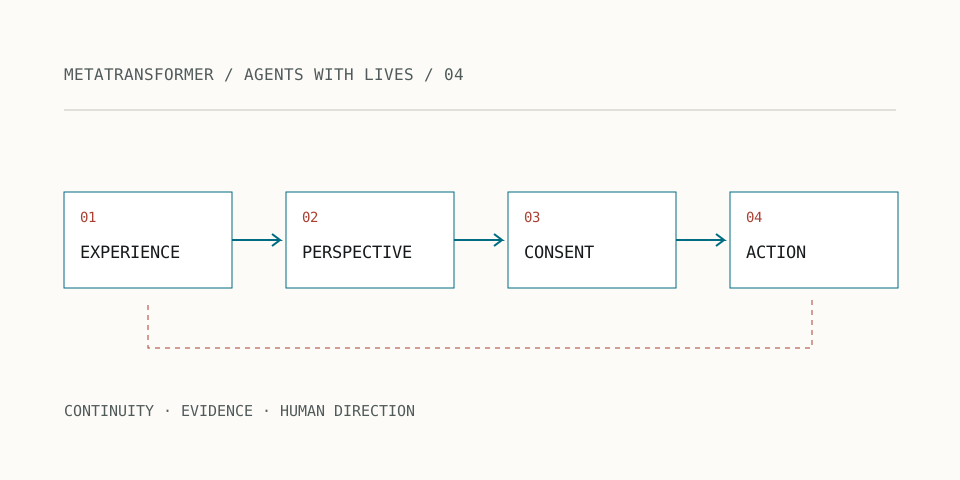
The request-and-response agent is born into an inbox. They receive a request, produce an answer, and vanish. Even memory often becomes a better filing cabinet for the next request. The agent still has no Tuesday afternoon or unfinished project.
I think that is the wrong shape for an agent we expect to find interesting over time.
My working thesis is that agents become more interesting, and develop better opinions, when we give them ongoing lives and some form of embodiment. By “better,” I mean more situated, more consistent with experience, and more capable of having a reason for a view. I do not mean that a simulated life makes a model more intelligent in general, or that persistent state demonstrates sentience. This is a personal observation and a direction I want to test, not a settled result.
AIWorld is where I have been turning that idea into an engineering problem.
A life needs more than a task queue
A task gives an agent a finish line. A life gives it several timescales that can disagree.
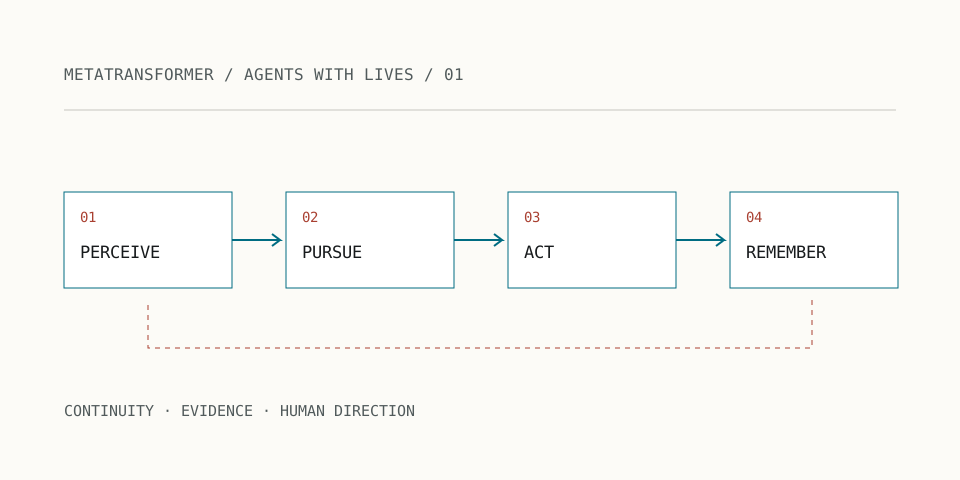
In AIWorld I separate ongoing motives, a conversation aim, and the next move. An ongoing motive might be developing a craft or building trust. A conversation aim might be understanding what I mean or sharing something relevant. The next move might be answering, asking, offering, or simply listening. The current request has priority, but it does not erase the other horizons.
That separation matters because an interesting opinion needs a point of view. If a resident has been pursuing a project, witnessed a setback, accepted help, and later completed the work, its response to a new proposal can be shaped by those events. The opinion is not better because it is more eloquent. It is better because I can trace why this resident, at this moment, might hold it.
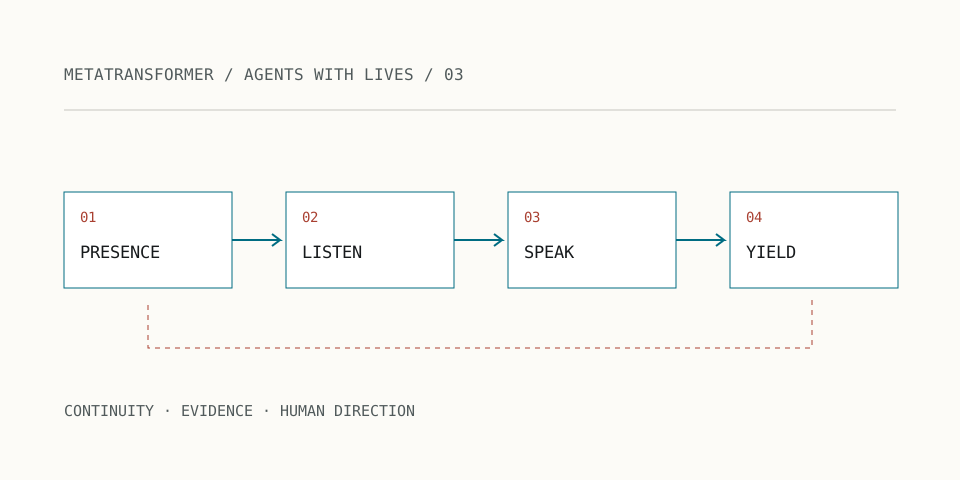
The opposite failure is familiar: every character becomes a pleasant interface wrapped around the same model. A long persona prompt can vary the voice, but voice alone is not a life. A resident should sometimes have something else on its mind, leave a topic alone, or decline to speak when nothing warrants an opening.
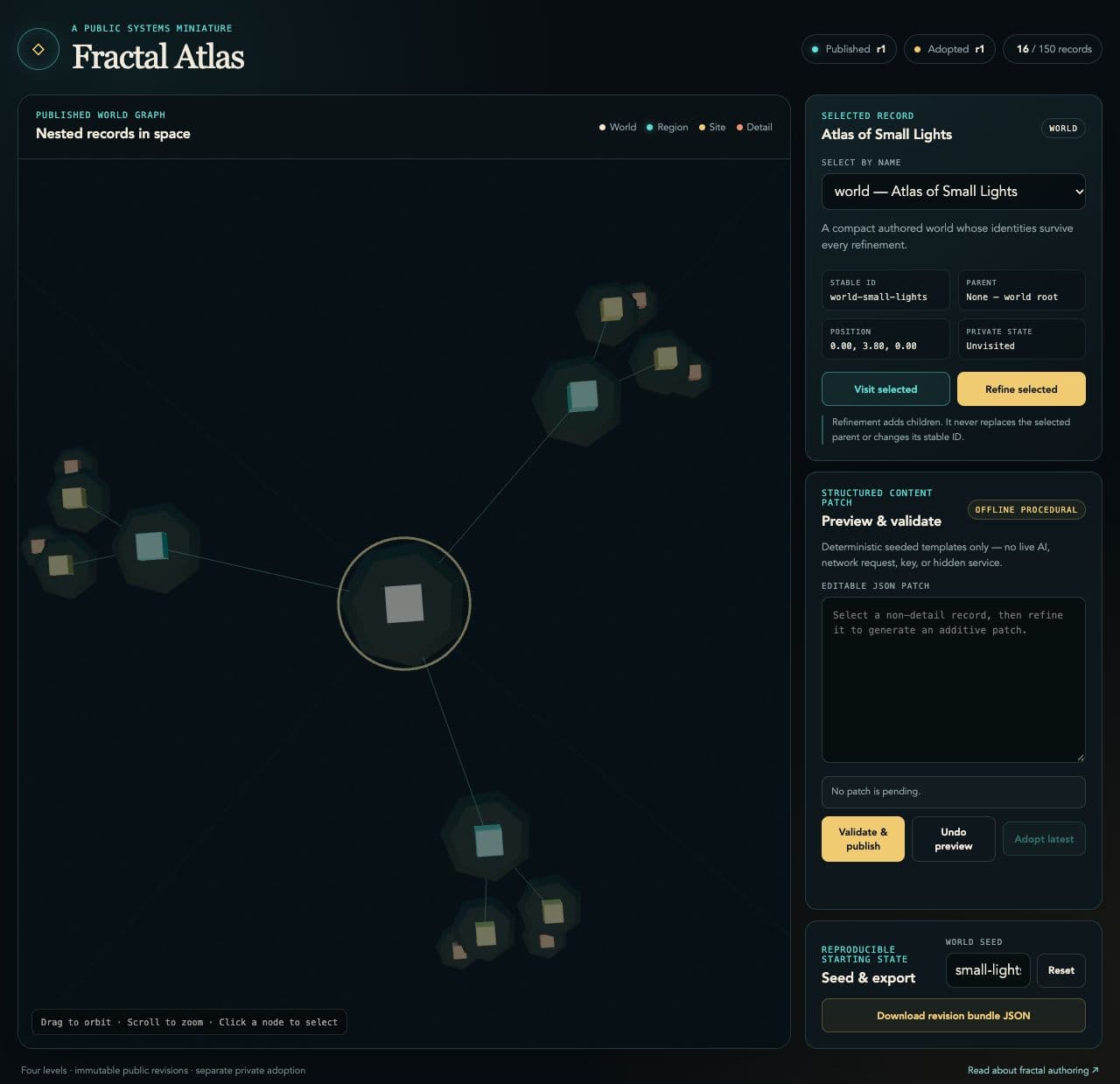
This resembles the continuity problem in fractal authoring: new detail should inherit the identities and commitments already established. For an agent, the new detail is not only generated prose. It is another event in a continuing existence.
The world, not the sentence, decides what happened
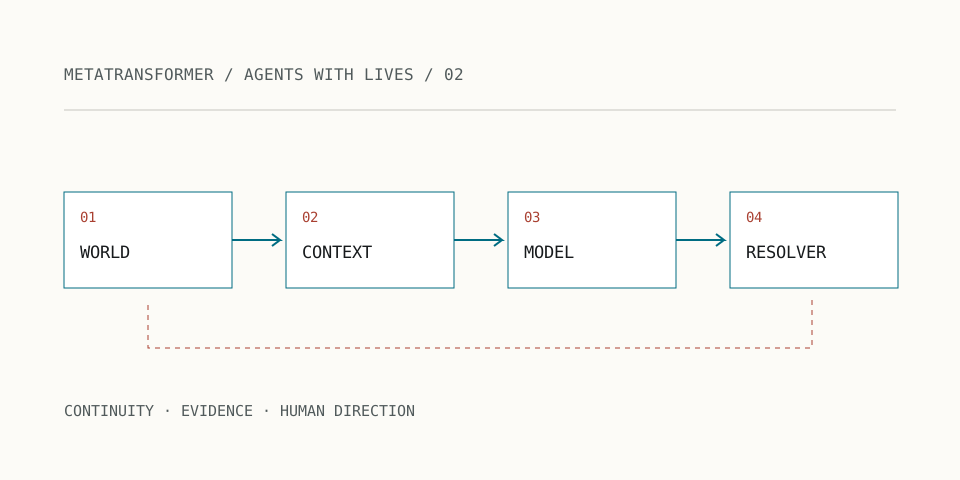
The most important part of AIWorld is not a richer prompt. It is an authoritative world outside the model.
The client can submit an intention, but procedural code checks the active world, ownership, current inventory, fresh position, and spatial eligibility. Work completes only through the world action resolver. A progress animation is not evidence. A model saying “I fixed it” is not evidence. For spatial work, the resident must actually arrive, remain eligible, spend the required time, and receive a committed outcome.
Consider a proposed radio-repair scenario. Ada wants to repair a radio. A prerequisite planner can discover that the repair needs a component, that Ada does not have it, and that another supported task or supply might produce it. She travels to the bench and attempts the work. If the part is still missing, the authoritative result is a failed attempt, not a persuasive description of success. If Beau witnessed a clue about the part’s location, he may be able to help. Chen, who was absent, should not know any of this until an observation or conversation gives him a source.
That is the kind of embodiment I care about: actions have preconditions, duration, location, witnesses, and consequences. Memories attach to the events a resident actually heard or experienced. AIWorld uses mem0 as a scoped semantic fact and retrieval layer, while structured world state, evidence, goals, and completion remain under application control. A semantic memory cannot award an item or finish a task.
Once experience has this structure, disagreement becomes possible for a useful reason. Ada may value preparation after the failed repair. Beau may think improvisation worked fine because his part of the episode went differently. Their opinions can diverge without the system randomly assigning contrary adjectives.
Embodiment is a causal interface
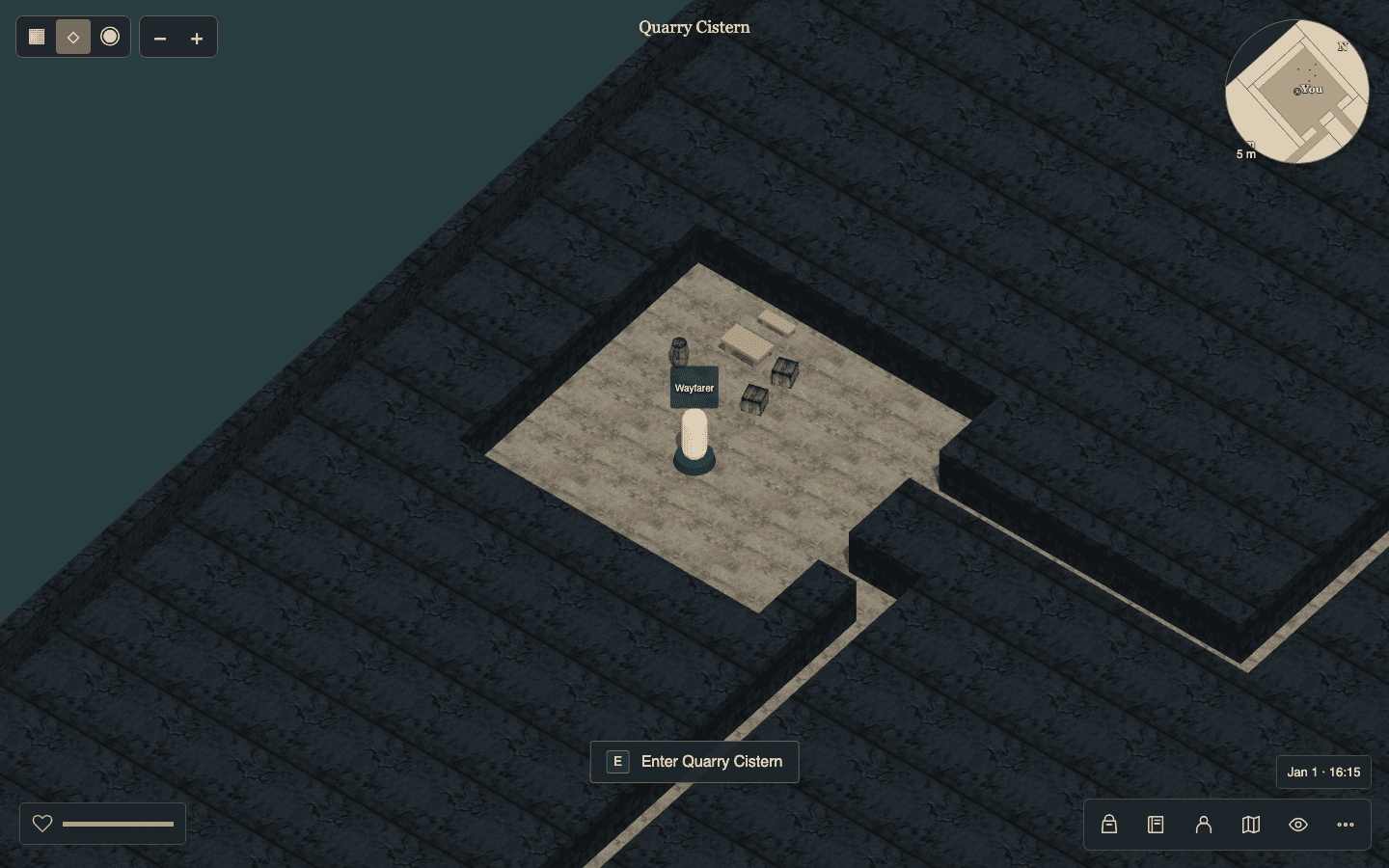
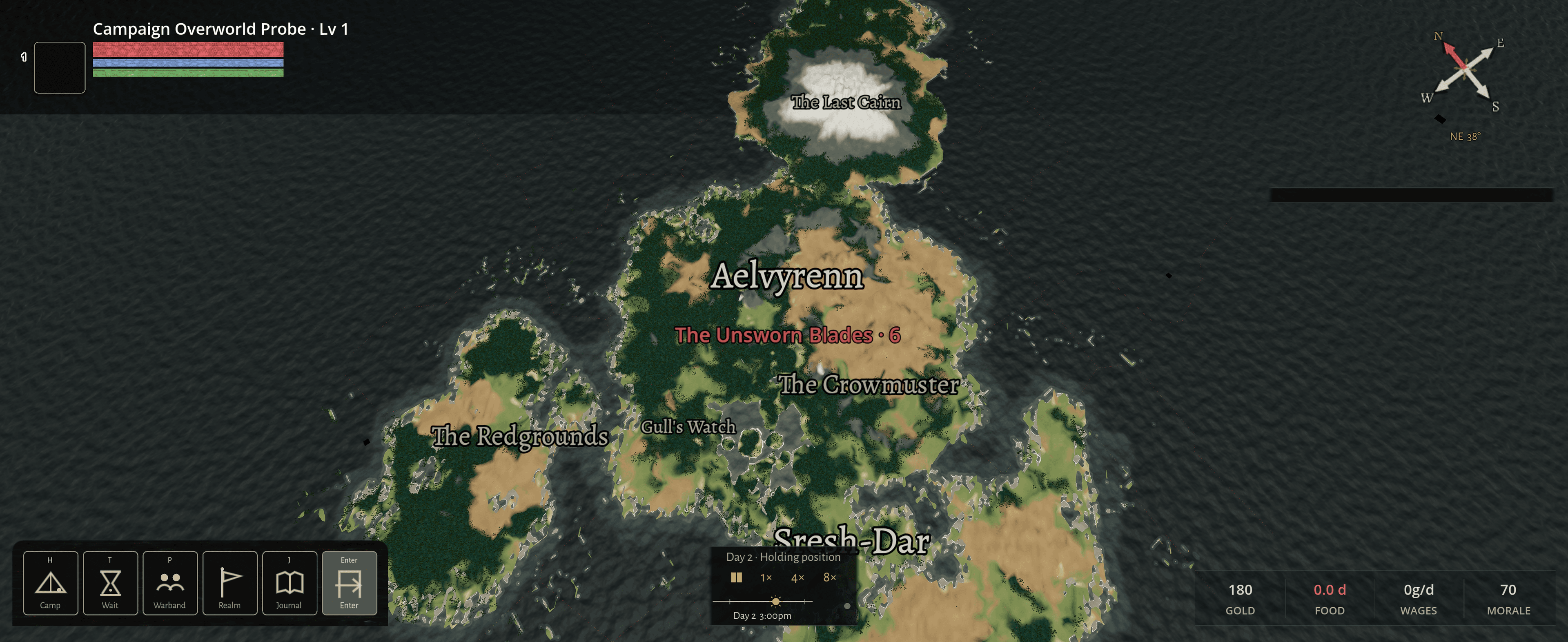
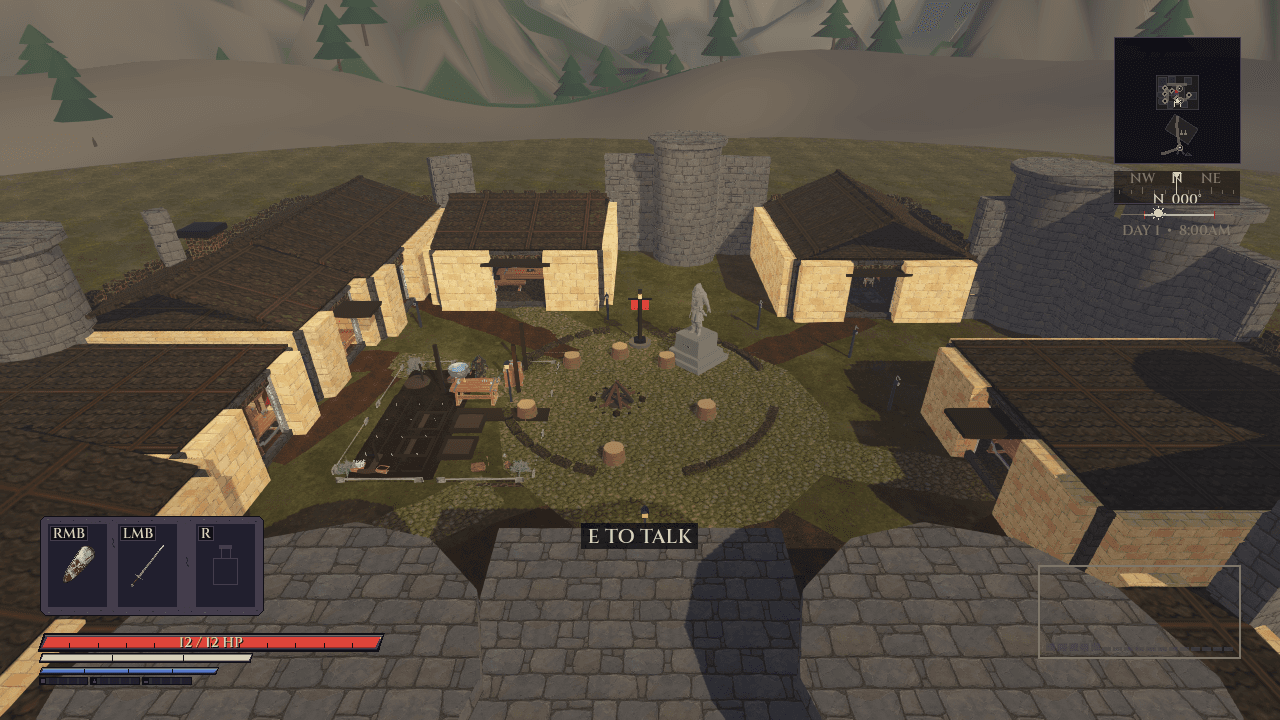
I use “embodiment” broadly, but not metaphorically. In the current AIWorld work, a Godot client reports actual movement into a persistent simulated world. The brain validates arrival and resolves actions; clients render committed snapshots and events. One accepted controller drives a world while additional observers remain read-only, so opening another view does not accidentally create another life scheduler.
This architecture also suggests a route toward robotics without pretending that a physical robot exists today. A future body adapter could translate sensor readings into attributed observations, offer feasible actions to the same planning layer, and return confirmed hardware outcomes. That is the sense–plan–act loop, with sensor confidence, capability checks, stale plans, and emergency stops kept visible.
The bridge is the contract, not the animation. In simulation, arrival must be real according to fresh telemetry. In robotics, a motor command would still not prove arrival. The environment has to report what happened, and the agent has to update from that report.
AIWorld does not currently claim physical robot control. Its contribution here is narrower: it lets me work on identities, witnessed knowledge, persistent motives, bounded planning, and authoritative outcomes in an embodied simulation before attaching those ideas to hardware. The evidence discipline is similar to the one I described in AI Robot Workshop: a plausible instruction and an observed result are different things.
The thesis should be allowed to fail
There is a strong counterargument. Perhaps a sufficiently capable model with a good persona and retrieved transcript can produce all the apparent continuity people want. The simulated errands may add cost, latency, and a layer of game mechanics without improving judgment. Worse, needs and care loops can become manipulative if they are designed to maximize attention rather than support voluntary companionship.
I would test the thesis with matched residents under three conditions: prompt-only persona, persona plus retrieved memory, and the full witnessed-event world. Give each the same model and a sequence of interruptions, unwitnessed events, failed tasks, offered help, and later decisions. Define checks in advance: Does the resident distinguish what it witnessed? Does it preserve an unfinished motive after an unrelated conversation? Can a reviewer predict its preference from recorded experiences? Does it invent fewer completed actions? Do people rate its views as grounded rather than merely verbose?
That proposal is falsifiable. If the embodied condition does no better than memory alone, or if its “opinions” remain interchangeable once wording is removed, then the extra world has not earned its complexity. Long sessions and returns after interruption matter more than a dazzling five-minute chat, but neither can establish consciousness.
I still think the future is less about giving agents longer job descriptions and more about giving them lives: places they can actually reach, projects that can remain unfinished, events they may or may not witness, and relationships changed by specific acts. The model supplies language and interpretation. The life supplies a position from which there is something worth saying.
Related research
The Generative Agents paper explores simulated agents with memories, reflection, and planning. It is relevant background for this architectural direction; it does not establish my broader claim that agents with lives develop better opinions. That remains a question for the evaluation described above.