The brief-to-copy workflow gives a marketing agent very little life. It receives a brief, produces some copy, and disappears. On the next task it may know the brand voice, but it has no durable position in a campaign, no memory of its paths, and no consequences beyond whether someone accepts the output.
After building marketing automation across Search Fund Ventures, SMB Capital Partners, and SMB Investor Network, I have come to think that the useful unit is not the prompt. It is the world around the agent.
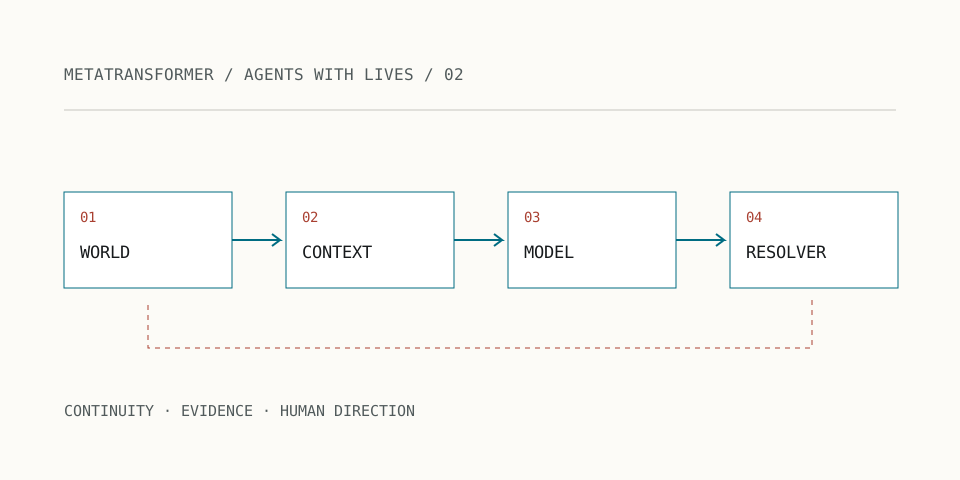
A marketing system already has the beginnings of a world: audiences, places, routes, rules, history, and observable events. Give an agent a persistent role there and “embodiment” becomes concrete. Its body is a bounded set of actions; its experience is the record of what happened afterward.
That is my opinion about where agents should go. The code establishes some necessary structure; it does not establish autonomous operation, an embodied-agent experiment, or a growth result.
Marketing already has geography
One implemented piece is a content graph. Each linkable page is a node with a type, URL, topics, suggested anchor language, and explicit relationships; nodes can also carry audience and access state. The graph can answer which pages are related and eligible for public link suggestions while recording whom the material is for. That eligibility is a routing policy, not an access-control guarantee.
An agent can begin at a known node, see that the intended reader is an investor, follow a relationship to an educational guide, and distinguish a public article from an email-gated report. A gated report can still have a useful public landing page; the route should lead to the intended gate rather than bypass it.
That is geography. Tags describe regions of meaning, related links are roads, and access rules are doors. The fields are simple; together they make the next action situated rather than guessed.
I see the same principle in fractal authoring: a generated addition becomes more coherent when it inherits identities and constraints from a persistent world. Marketing content is less dramatic than an RPG landscape, but it has the same structural problem. A new page should join what already exists without erasing the commitments around it.
Actions need rules and consequences
The call-to-action registry supplies a small action system. It defines CTAs, placement slots, brand and content filters, and destination availability. Resolution is ordered: a page-specific choice can control an end slot; an associated guide can control a mid-article slot; otherwise the first eligible placement wins. A rule can deliberately render nothing.
That ordering matters because “add a CTA” is not one action. The available move depends on location and state. A newsletter that is not collecting should not be offered. A guide should not be selected if its landing page is unavailable. An explicit absence should not be filled by an overeager fallback.
Campaign work is represented as records too. Content pieces can be queried by campaign, status, format, and platform, then updated as their state changes. A publication transition can carry its own timestamp, making the campaign inspectable over time.
Again, the boundary is important. A route that lists and updates campaign records proves that those state transitions are structurally available. It does not prove that an agent chose the transition, that publication actually reached an audience, or that the work performed well.
One illustrative path through the world
Consider an invented example. This is a walkthrough of the mechanism, not real lead data.
Suppose an education site has an article for prospective small-business investors, a downloadable evaluation guide, and a signup page on an investing network. The article exists in the content graph. Its topics and audience connect it to the guide. The guide is active in the CTA registry, so the article's mid-page slot can resolve to that resource. A later CTA can point to signup with tags describing the source site, the content channel, and the slot that produced the link.
A reader moves from the education site to the guide and later to signup. The attribution mechanism retains the first tagged visit in a first-party browser cookie, configured for 90 days. Later visits do not overwrite a valid stored touch. Clearing the cookie, using another browser, or returning after it expires can start a new attribution history. The record can include source, campaign slot, initial landing path, referrer, and time; signup can preserve it.
Now the environment has an observable outcome: a tagged arrival was recorded and a signup record exists. An agent could compare that event with campaign state and propose strengthening the route, revising the article, or leaving it alone.
It still could not honestly say the article caused the signup. First-touch attribution is a recording policy, not a causal model. The reader may have encountered other material, received a recommendation, or already intended to join. A signup is a funnel signal, not proof of persuasion, revenue, or incremental lift. The structure gives an agent evidence to reason about; it does not grant the evidence powers it does not have.
Is this really a world?
The fair counterargument is that this is a content management system with a grand name. An API, a graph, and a few registries do not make an agent alive. A stateless model can call tools without a fictional biography.
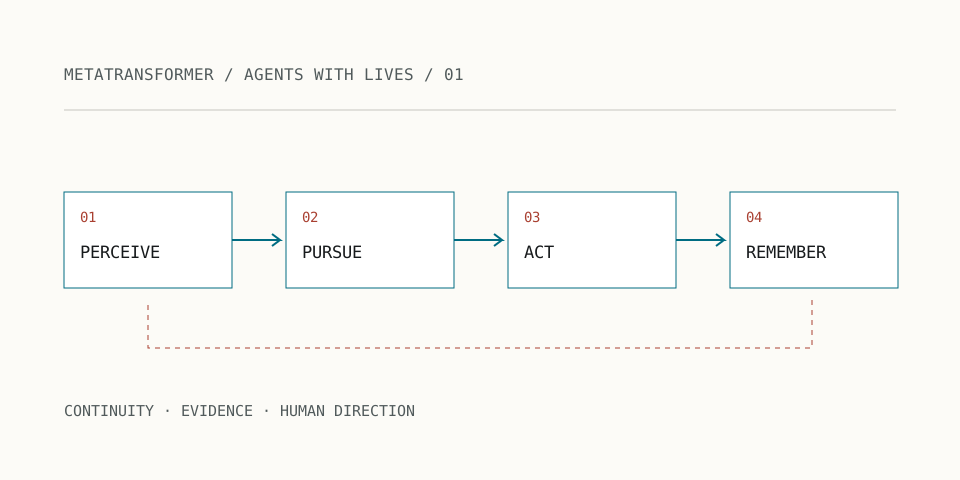
I agree with the first half. The metaphor becomes useful only when history changes the agent's future options. If a campaign has a durable goal, if published pieces remain part of its surroundings, if attribution events become observations, and if availability rules constrain the next move, then the agent is no longer operating on interchangeable prompts. It occupies a position.
That kind of embodiment needs no humanoid avatar. Its senses are permitted records, its hands are permitted actions, and its body ends at the permission boundary. Its memory is campaign history, including rejected proposals and uncertain results. As in Treasure Hunter, observations, estimates, and unknowns need different types; otherwise the agent's “experience” becomes a story it tells itself.
The limitation today is straightforward: the projects described here provide structural mechanisms, not a qualified autonomous loop. I am not presenting model trials or observed agent behavior in this essay. Human judgment still supplies the strategy, reviews the content, and decides what the available signals mean.
Give the agent a life
My future proposal is to make that loop explicit. Give a marketing agent an ongoing campaign identity, a bounded audience, a map of content, a budget of actions, a record of decisions, and feedback that preserves uncertainty. Let it develop preferences because it has to live with previous choices.
Digital twins are especially interesting here if we use the term carefully. A useful twin would model an audience or campaign environment: current beliefs, supporting evidence, and known failures. An agent could rehearse routes, argue with alternative audience models, and state what would change its mind. The twin would not be a customer oracle. Real people remain more surprising than any segment model, and simulated approval is not market evidence.
I suspect agents become more interesting, and develop better opinions, when their judgments accumulate consequences. That is a thesis, not a result claimed by the current code. But marketing is a good place to test it because so much of the world is already present. The audiences, artifacts, paths, gates, and event records exist; they are merely scattered across tools.
Bring those pieces into one persistent environment and an agent can do more than generate another asset. It can remember where it stands, explain why a move is available, observe what followed, and revise its view without pretending a signal is a cause. Give an agent that kind of life, and its opinions finally have somewhere to come from.